May 24 2013

Photo Finish for May 24, 2013: Ozy* Can You See?

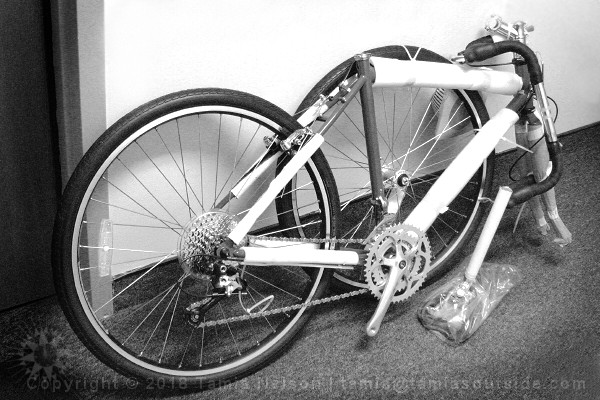
I have it on good authority that it takes a whole village to raise a churl. Well, there’s at least one hamlet on The River that took its responsibilities seriously. And here’s the final product. Just in time for the long weekend that marks the quasi-official start of the shearing season for summer tourists.

The message? What about “Look on my work, ye boosters, and despair”? I think that gets the meaning across, don’t you?

* Short for Ozymandias.

Boor Spoor

Questions? Comments? Just click here!

May 23 2013

Heat-and-Eat — Rice on the Go

Rice feeds much of the world. And it feeds me, too. At the moment, I have no fewer than six varieties in my home pantry: long‑grain white basmati, long‑grain brown basmati, medium‑grain all‑purpose, short‑grain rose rice, short‑grain Arborio, and wild rice. (Wild rice isn’t a true rice, by the way — though the taxonomists tell us it’s a “close cousin” of the real thing.) Nor is rice restricted to stay‑at‑home dinners. It also figures regularly in my camp menus. Its mild flavor makes it a good base for stews, chili, and chunky sauces, as well as a versatile side dish. Rice can also be used in carry‑along snacks, either savory or sweet. But don’t be deceived by its self‑effacing character. Rice can stand on its own when it has to, taking the starring role in stick‑to‑your‑ribs meals like risotto or pilaf. It’s at its best when heading an able ensemble cast, however. I’ve auditioned nuts, fruits, vegetables, eggs, cheeses, and meat for these supporting roles, and they’ve all won rave reviews.

None of this would matter if rice weren’t a good traveler, though. Luckily, it is. If you pack it in doubled freezer bags and keep it dry, it won’t spoil, even on extended expeditions. And a little goes a long way: When used in a main dish, one cup of dry rice will be enough to satisfy two hungry paddlers. As a side dish, the same amount will feed four.

But rice also has its problems. While a much‑ballyhooed analysis purporting to show grossly elevated levels of lead in rice has now been “cast into doubt,” concerns remain about arsenic. That being the case, what’s a cautious paddler to do? I vary my diet and hope for the best. Others will decide to eschew rice altogether — and then wait anxiously to learn what poisons lurk in other staple foods. A more or less constant stream of bad news on this score is inevitable. There are tens of millions of new mouths to feed in the world every year, and nobody’s making more land. Which means that intensive industrial agriculture is increasingly the norm. Moreover, ours is now a global food economy. The task of inspecting the resulting flood tide of industrial eatables as it surges around the world is daunting. Yet with very few exceptions, the appetite for government regulation in all areas of life is on the wane. You don’t need to be a weatherman to see which way this wind is blowing.

Such Big Issues aside, rice has two other, lesser drawbacks. It takes a long time to cook from scratch: between 15 minutes and one hour. And it needs constant attention. It’s often been said that a watched pot never boils, but it would be far more accurate to say that an unwatched rice pot always boils over. No camp cook is going to rejoice at the need for constant vigilance, nor will he welcome an hour‑long stint of KP at the end of a hard day. There are plenty of quick‑cooking varieties of rice, of course, and I occasionally make use of easy‑to‑prepare rice and sauce mixes like Knorr Rice Sides. I don’t find them particularly tasty, however, and so‑called instant rice falls short in both nutrition and texture. The flavor leaves much to be desired, too.


The upshot? In the past, when I’ve wanted rice in camp, I’ve usually cooked it from scratch. But that may now be about to change. There’s a new kid on the block: heat‑and‑eat rice… Read more…

Take Your Pick of Ready to Eat Rice

Questions? Comments? Just click here!

May 21 2013

The Think Tank Glass Taxi: A Camera Bag for All Reasons
A Review by Pat McKay

If you’re a “serious” photographer, you’ll probably pick up lenses like a gun dog picks up ticks. And you’ll likely find yourself taking them everywhere you go, too. Which is where camera bags come in. Lenses — and here my “tick” simile breaks down — are fragile things, easily put out of action by vibration, dust, or moisture.

So your camera bag is your (and your lenses’) first line of defense. To be honest, I’ve never had one I was entirely happy with. But TNO Contributing Photographer Pat McKay may now have found The Answer. Let’s let him tell the story:

I needed a good bag to carry [a new] lens around and settled on the Glass Taxi. It's proven to be a great camera bag. (I'm a big fan of Think Tank products. I own three of their bags.)

There are a lot of things to like about the Glass Taxi. First of all, it can be configured in any number of different ways depending upon what you want to bring with you. Second, it's very comfortable to wear even if you carry a lot of weight. And third, it doesn't scream camera bag when you're walking around or on your bike. It looks more like a daypack or hydration pack.

Currently I have the bag configured to carry the DSLR and the new telephoto with hood attached, along with several other zoom and prime lenses, as well as a flash. The bag handles all this with aplomb.

Pat’s glowing endorsement doesn’t leave much room for doubt, does it? But let’s take a closer look at some of the fine points:

Pat McKay Glass Taxi Camera Bag

The bike is Pat’s Long Haul Trucker, and he occasionally wears the Glass Taxi as a backpack on short rides. Mostly, though, he carries it when afoot in the field. Not that it wouldn’t look good on the boulevard, too. Check this out:

Pat McKay Glass Taxi Camera Bag

Of course, a pretty face isn’t everything. A backpack is only as good as its harness, after all. And here, too, the Glass Taxi comes up trumps:

Pat McKay Glass Taxi Camera Bag

Nor do the appointments disappoint:

Pat McKay Glass Taxi Camera Bag

The padded partitions can be reconfigured to accommodate just about any lens inventory, and there’s also a handy mesh pocket inside the flap to hold those essential bits and bobs that would otherwise get lost in the dark corners.

Bottom line? The Glass Taxi is ready and willing to take you (and your camera kit) almost anywhere you’d want to go, swiftly and with style. Thanks for the heads-up, Pat!


Further Reading


Questions? Comments? Just click here!

Older Articles »
